Civil disobedience & political awakening
Refusal as a method
Between 1932 and 1933, Matangini Hazra broke a law, refused a tax, went to prison, was beaten in the street, and went back. This is what that actually involved.
First, the method
What civil disobedience actually asked of a person
It is easy to say the movement was non-violent. It is more useful to be specific about what non-violent non-cooperation required from the people who practised it.
Break a specific law
Not protest in general, but commit a defined, punishable act — make salt, refuse a tax, picket a shop — and do it openly, under your own name.
Accept the penalty
The point was not to evade arrest but to invite it. A movement in which everyone escaped punishment would have demonstrated nothing.
Do not strike back
Non-violence was a binding discipline, including under a baton charge. Retaliation would have handed the administration its justification.
Return afterwards
The hardest requirement. A single arrest is an incident; a movement needs people who come out of prison and rejoin. This is what Matangini Hazra did.
The salt law, broken at Alinan
The colonial state held a monopoly on the manufacture and sale of salt. Because salt is a necessity that everyone buys and no one can do without, the monopoly was both lucrative and, as a political target, unusually legible: breaking it required no argument to explain.
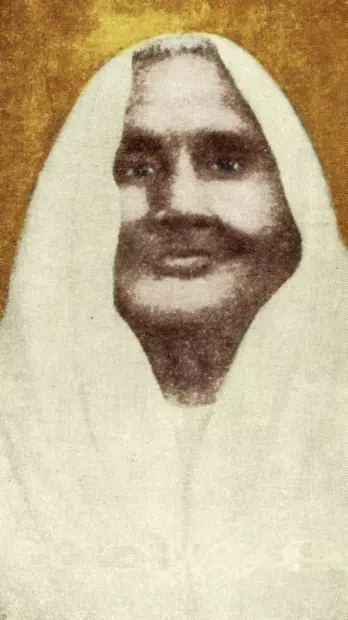
Matangini Hazra joined a Civil Disobedience procession and took part in the manufacture of salt at Alinan — the village of her late husband’s family — in open breach of the law. She was arrested for it and released soon afterwards.
She was then in her early sixties, and this is the first political act of hers that the record documents. Accounts also associate her participation with a procession on 26 January, the date the Congress had adopted as Independence Day.
The tax
The chowkidari tax, and why it was chosen
The chowkidari tax funded the chowkidar, the village watchman — the lowest and most locally present rung of the colonial policing system. It was a small levy, collected directly from ordinary cultivators.
As a target it was close to ideal. It was paid by everyone the movement wanted to reach. It funded something villagers experienced as surveillance rather than as protection. And refusing it required nothing but collective nerve — no literacy, no travel, no money.
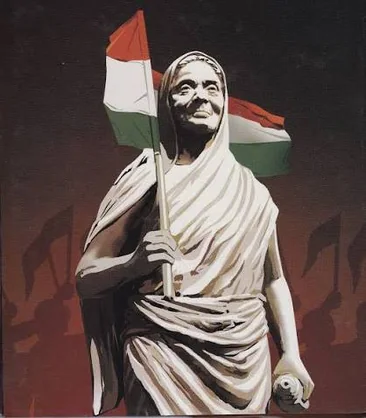
Matangini Hazra joined the agitation, taking part in a march toward the court building in protest against a court the movement regarded as illegitimate. This time the administration did not simply release her. She was sentenced to six months’ imprisonment, served at Baharampur jail in Murshidabad district — well outside her own subdivision.
Serampore, a baton charge, and a black flag
After her release she attended the subdivisional Congress conference at Serampore. The gathering was broken up by the police, and she was injured in the baton charge — at an age when a lathi blow is not a minor matter.
Accounts from the district also place her in a black-flag demonstration against Sir John Anderson, then Governor of Bengal. The black flag was the standard nationalist gesture of protest against a visiting colonial official: a silent, unmistakable withdrawal of consent.
Neither episode made her nationally known. Both established her, within Medinipur, as someone who could be relied on to be present.
On sequence and dating. Published accounts do not agree in every detail on the order of these events, and some compress them. What is consistently recorded is the set of acts themselves: salt, the chowkidari tax, the prison term, Serampore, and the black-flag protest.
Between the campaigns
The spinning wheel, kept turning
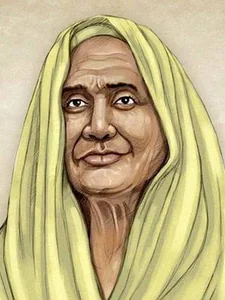
Between arrests, the everyday form of her politics was khadi. She spun her own cloth and continued to do so as her eyesight failed and her age advanced.
It is worth taking this seriously rather than treating it as a picturesque detail. Hand-spinning was the movement’s answer to a genuine economic argument: that colonial trade had destroyed Indian textile production and left rural households with no off-season income. Spinning was simultaneously a protest, a small economic act, and a daily discipline.
For women in particular it had a further significance: it was a form of political participation that could be practised inside the household, by people who could not easily leave it. It made a political movement available to the least mobile half of the population.
Next chapter
Then, in August 1942, the rules changed
Everything on this page happened within the framework of a movement that had leadership, instructions and a strategy. In 1942 that framework was removed overnight.