The Tamluk march
29 September
1942
Six chapters, in sequence. Told from the published record, without invented dialogue and without graphic detail.
The moment
A district that had decided to govern itself
The Quit India resolution had passed on 8 August 1942. By the morning of 9 August the Congress leadership was in prison, the organisation was banned, and there was no one left to issue instructions.
In Medinipur the local movement drew a maximal conclusion: if the demand was that the British quit India, then the immediate objective was to remove colonial administration from the district. Not to petition the police station — to take it.
Preparation was practical. Volunteer batches were organised across the Tamluk subdivision, with training in drill and in attending to casualties. On the night of 28 September the main link roads were cut at several points and communication lines severed, to slow reinforcement.
Actions were set for the following morning at three centres at once: Tamluk, Mahisadal and Sutahata.
The procession
Roughly six thousand people, most of them women
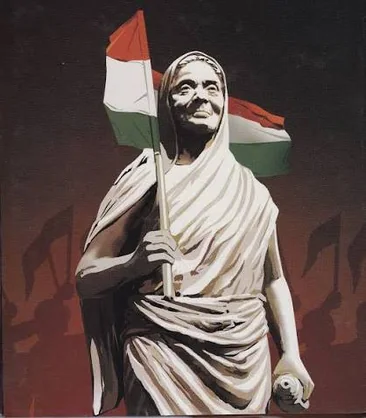
On the morning of 29 September a procession moved toward the police station and administrative buildings at Tamluk. Accounts put its size at around six thousand, a large proportion of them women volunteers. Matangini Hazra was at its head.
She was then in her seventies. She had joined her first procession a decade earlier, had been arrested twice, had served six months in prison, and had been injured in a baton charge at Serampore. None of that had removed her from the front of a march.
The objective was specific and limited: to take possession of the police station and raise the national flag over it.
The advance
The order to disperse
At the outskirts of the town the procession was met by police and ordered to break up under Section 144 of the Code of Criminal Procedure — the standing colonial provision empowering a magistrate to prohibit the assembly of people in a given area.
Section 144 is worth naming precisely, because it is the mechanism by which the entire confrontation was made lawful in advance. It converted the act of walking down a road together into an offence, and it made whatever followed a matter of enforcement.
Accounts describe Matangini Hazra stepping forward, ahead of the crowd, and appealing to the police not to fire on it.
She was shot.
A note on Section 144. It is frequently cited — including in many accounts of this event — as a section of the Indian Penal Code. It is not. It belongs to the Code of Criminal Procedure, which governs process rather than offences. The distinction matters because it identifies the order as an administrative prohibition rather than a criminal charge.
The flag
Why the flag is the fixed point in every account
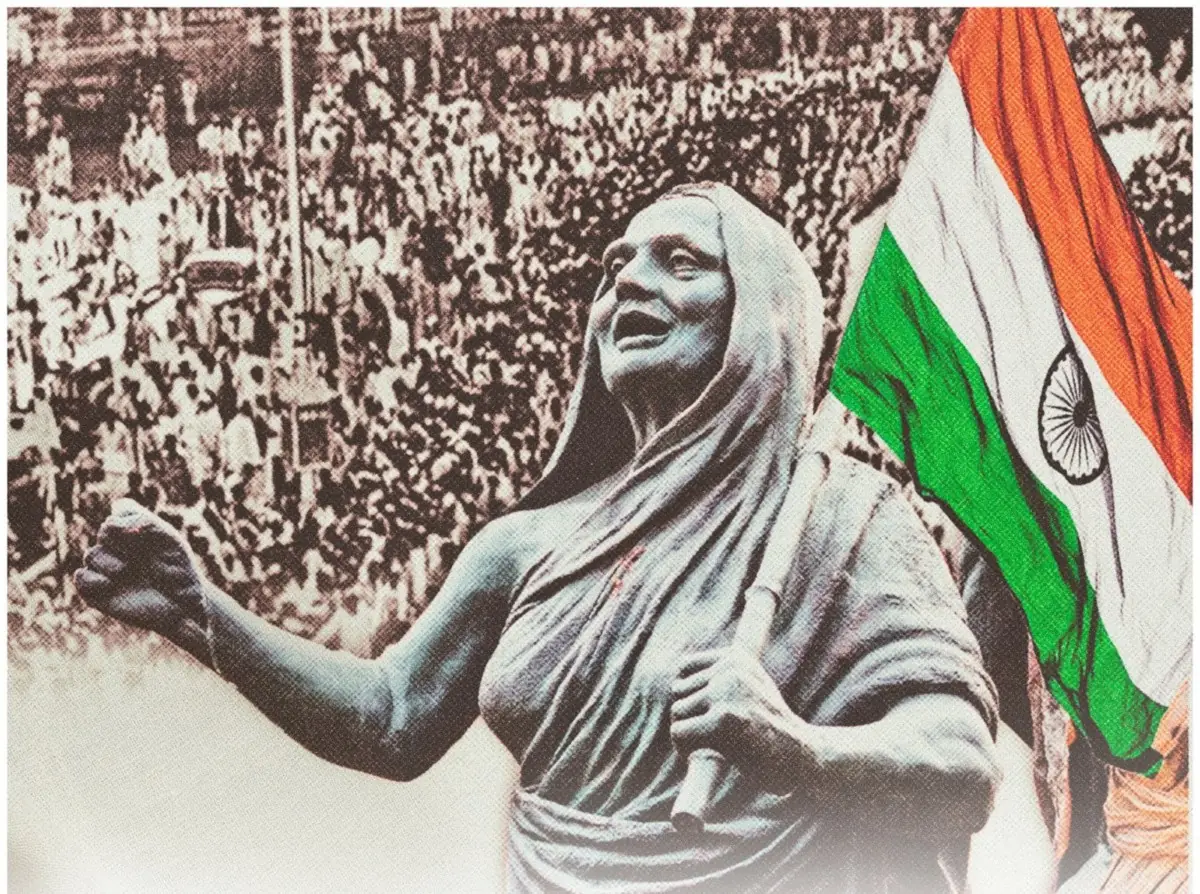
In every version of this event, from the contemporary nationalist press to the statues raised decades later, one element is constant: she was carrying the flag, and it did not reach the ground.
The flag was not decorative. Raising the national flag over a police station was the entire objective of the action — the visible, unambiguous assertion that the building now belonged to a different authority. To carry it at the head of a procession was to carry the purpose of the march itself.
It also explains why accounts dwell on the detail of her continuing to hold it. In the symbolic logic of the moment, the flag falling would have meant the action failing. Her holding it meant the procession still had its objective in hand.
The final moment
What the record says, and no more
The contemporary nationalist newspaper Biplabi reported that after being hit she continued to advance with the tricolour held up; that she was struck again; and that she was wounded in the forehead and in both hands. Accounts agree that she went on calling Vande Mataram, and that she died still holding the flag.
She is recorded as the first person killed in Medinipur during the Quit India Movement.
That is the extent of what the sources establish. There is no verified record of any words she spoke beyond the invocation of Vande Mataram, no transcript of an exchange with the police, and no eyewitness statement attributed to her by name. Popular retellings that supply her with a final speech are supplying it.
Where sources disagree. The number of shots is given variously as one, two or three. Her age is given as 71, 72 or 73, depending on whether a source follows an 1869 or 1870 birth year. This site records the disagreement rather than resolving it in favour of the most striking version.
Her body fell.
The idea she stood for did not.
An interpretive statement written for this site. It is not a historical quotation, is not attributed to Matangini Hazra, and does not appear in any contemporary source.
What remained
She was one of many, and the many are the point
Nine other people were killed at Tamluk that day, among them two boys aged thirteen and fourteen. Accounts record further deaths at Mahisadal and at Nandigram. The repression that followed across the district was severe and prolonged.
Less than three months later, on 17 December 1942, the Tamralipta Jatiya Sarkar was constituted — a parallel government for the Tamluk and Contai subdivisions, with Satish Chandra Samanta at its head and an armed wing, the Bidyut Bahini, under Sushil Kumar Dhara. It ran courts, collected revenue, maintained order and organised relief after the cyclone of 16 October 1942, which the colonial administration had largely failed to address.
It functioned for roughly twenty months, until it was wound up on 8 August 1944 at Gandhi’s request. It remains the longest-lasting parallel government of the Quit India period.
This is the most accurate way to state what her death led to. Not a change of heart in the administration, and not independence — that was five years away. What followed was that a district went on to govern itself for nearly two years.
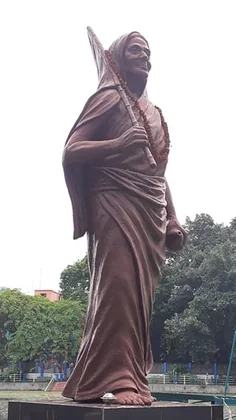
The statue stands where the procession was stopped
A memorial marks the place in Tamluk where she was killed. It shows her in motion, mid stride, with the flagstaff over her shoulder — not standing still and not fallen.
It is an accurate choice. Whatever else is uncertain in the record, every account has her moving forward.