Chapter 01 · Origins
A life before history
knew her name
Seventy of her seventy-odd years left almost no documentary trace. What follows is the little that is recorded, and the historical context that gives it meaning.
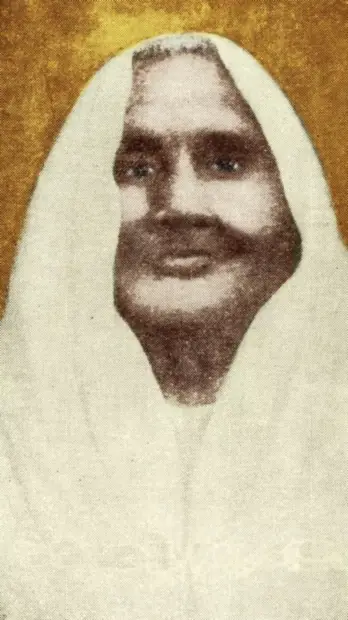
Hogla village
Medinipur district, Bengal Presidency — a few miles from the subdivisional town of Tamluk, on the rice plain of the Rupnarayan.
Matangini Hazra was born on 19 October 1869 at Hogla, a village close to Tamluk. Her father, Thakurdas Maity, was a poor peasant. The family belonged to the Mahishya community, which formed the great majority of the cultivating population of the district. There was no land to speak of, no surplus, and no expectation that a daughter would be educated.
She never learned to read or write. This is not a footnote to her life; it shaped everything about how she would later participate in politics. She could not have been reached by a pamphlet, a newspaper or a manifesto. Whatever brought her into the national movement had to arrive in person — as a meeting, a procession, a spinning wheel, or a neighbour.
A note on the date. Published sources give her birth year as either 1869 or 1870, with 19 October appearing consistently as the day. Neither year can be treated as settled. The disagreement is why her age at death is variously reported as 71, 72 or 73.
Marriage, and then widowhood
Married at about twelve.
Widowed at eighteen.
She was married as a child — accounts give her age as around twelve — to Trilochan Hazra of Alinan, a man very much older than she was and already a widower. Child marriage was ordinary in rural Bengal at the time; so was the large age gap.
Six years later she was a widow, and childless. She returned to Hogla and lived separately from her husband’s household, which had no obligation to her and offered her nothing.
The record contains no account of what she felt about any of this, and this site will not invent one. What can be described accurately is the position she was left in.
The general social conditions of widowhood in late nineteenth-century rural Bengal. These describe the world she lived in; they are not claims about her personal feelings or private circumstances, which the record does not preserve.
Roughly 1887 to 1932
Forty-five years the record barely touches
Between her widowhood and her first documented political act, almost nothing about her life is written down anywhere.
This silence is not unusual — it is the normal condition of the historical record for poor rural women in colonial India. Nothing about her life generated a document. She paid no significant revenue, owned no registered property, appeared in no census return that survives with her name on it, wrote no letters and received none.
What does survive comes from later recollection within her own district: that she supported herself by her own labour, that she was known for helping the households around her, and that during an outbreak of smallpox in the area she nursed the sick — men, women and children — when others would not go near them.
These accounts were collected after she became famous, which is a reason for care in reading them. But they are consistent with each other, they are local rather than national in origin, and they describe something unglamorous rather than heroic. Long before she was political, she was useful to her neighbours.
How to read this section. Where this site says “accounts describe” rather than “she did”, that difference is deliberate. It marks the boundary between what is documented and what is remembered.
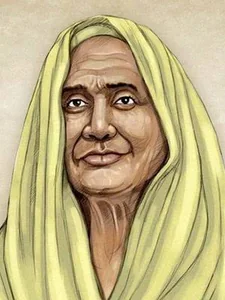
The threshold
She was in her sixties when she first walked in a procession
It is worth pausing on the arithmetic. By 1932, when she is first recorded joining a Civil Disobedience procession, she had been a widow for around forty-five years. She was in her early sixties. She had no political history, no organisational role, no education and no property.
Nothing in her circumstances required her to take any of this on. She had already outlived most of the expectations her society had of her. What she did next was entirely additional — and it occupied the last decade of her life.