The Quit India Movement
1942: a movement with its leadership in prison
Within hours of the Quit India resolution, the British administration removed almost everyone capable of directing the campaign. What happened next was decided in the districts.
Section 01
The political situation of 1942
By 1942 the Second World War had reached India’s frontier. Britain had entered India into the war in 1939 without consulting Indian political opinion, which was resented across the spectrum. Singapore had fallen in February 1942; Burma followed; Japanese forces were on the eastern border and Japanese aircraft had bombed Indian territory.
The Cripps Mission arrived in March 1942 offering dominion status after the war. The Congress rejected it. Its assessment was that Britain could not defend India, would not transfer real power, and was extracting Indian resources and manpower for a war Indians had not been asked about.
On 8 August 1942, in Bombay, the All India Congress Committee passed the Quit India resolution, demanding an immediate end to British rule. Gandhi’s instruction to the country was to act as free people.
The response, within hours
The administration had prepared. In the early hours of 9 August, Gandhi, Nehru, Patel, Azad and effectively the entire Congress leadership were arrested, along with provincial and district office-holders in very large numbers. The Congress was declared unlawful. Its offices were occupied and its funds frozen.
The intention was decapitation, and in one sense it succeeded: there was no leadership left to negotiate with. But it also meant there was no leadership left to restrain anyone. The movement did not stop; it devolved.
Section 02
How a national decision became a local rising
The relationship between the Congress high command and a district like Medinipur in 1942 was not one of command and obedience. After 9 August it could not have been.
National resolution
8 August 1942: the AICC demands an immediate British withdrawal. The instruction to the country is broad and unspecific by design.
Leadership removed
9 August: mass arrests eliminate the national and most of the provincial leadership. No one remains who can issue detailed instructions.
Districts improvise
Local organisations interpret the resolution themselves. Outcomes vary enormously by district, depending on how deep local organisation already ran.
Medinipur acts
Here the interpretation is maximal: not protest against the administration, but the removal of it. Police stations, courts and offices become the objective.
Why this matters for reading 1942. The violence and the radicalism of the 1942 movement are often laid at Gandhi’s door or treated as a failure of discipline. The more accurate description is structural: a mass movement was given a maximal demand and then stripped of the leadership that would have moderated its methods.
Section 03
Why Medinipur went further than most
Medinipur had a long history of nationalist organisation, reaching down to village level, and a population with direct experience of the earlier no-tax and salt campaigns. When the 1942 moment arrived, the district had something most did not: an existing structure that could act without instructions.
Preparation
Volunteer batches were organised across the Tamluk subdivision, drawn largely from young men and students, with training in drill and in attending to casualties, under the direction of Sushil Kumar Dhara. On the night of 28 September the important link roads of the subdivision were cut at several points and communication lines were severed, to slow the movement of reinforcements.
29 September 1942
On the following morning, coordinated actions were mounted against the police stations at Tamluk, Mahisadal and Sutahata. The objective was to take possession of them and hoist the national flag.
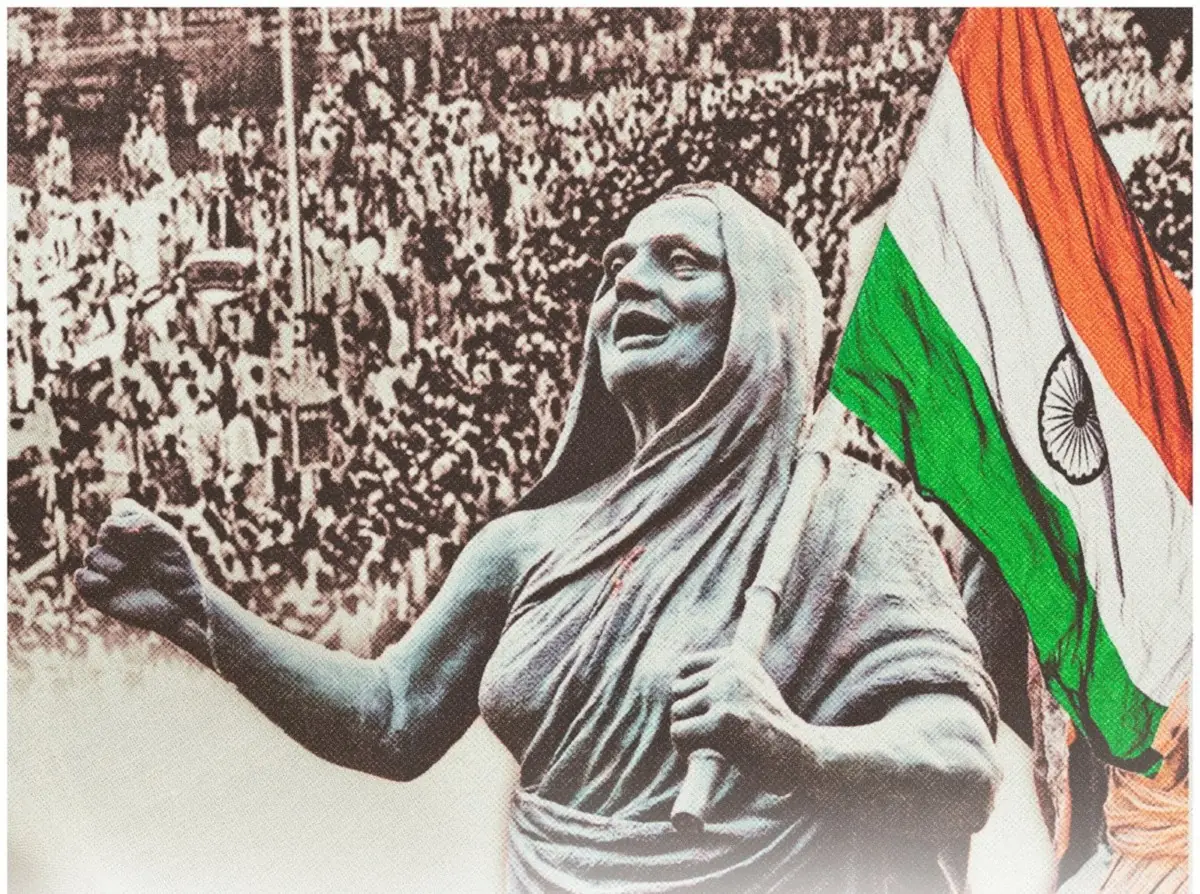
It was during the action at Tamluk that Matangini Hazra was shot and killed while carrying the flag at the head of the procession. She was not the only casualty: accounts record nine others killed at Tamluk that day, including two boys aged thirteen and fourteen, with further deaths at Mahisadal and at Nandigram.
On the numbers. Casualty figures for September 1942 in Medinipur vary between sources and were, at the time, actively disputed by the administration. The figures above follow published historical accounts of the district; they should be read as the best available record rather than as a precise count.
Section 04
What followed, and what it cost
The repression in Medinipur after September 1942 was severe, and it coincided with two catastrophes that had nothing to do with politics.
The administration responded to the risings with mass arrests, punitive fines and widespread police and military action across the district. Contemporary and later accounts record extensive violence against the rural population, including sexual violence against women — a factor that shaped how the local movement subsequently organised its women’s wing.
On 16 October 1942 a severe cyclone struck the coastal Medinipur region, causing enormous loss of life and destroying the standing crop. Relief from the administration was minimal, and its failure became a political fact in itself. Local Congress workers organised relief on their own.
The following year brought the Bengal famine of 1943, in which millions died across the province — a catastrophe of policy, procurement and denial as much as of harvest.
It was into this that the Tamralipta Jatiya Sarkar was formed on 17 December 1942 — a parallel government for the Tamluk and Contai subdivisions, which ran courts, an armed wing and a relief apparatus, and which functioned until it was wound up at Gandhi’s request on 8 August 1944.
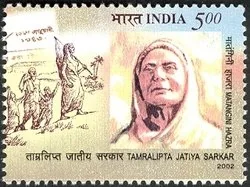
Sixty years later, the state commemorated what it had once suppressed
The 2002 stamp places Matangini Hazra alongside a depiction of the procession, under the name of the parallel government her death helped bring about. It is a small object, but a precise one: it commemorates not an individual martyrdom but the government that followed from a district’s decision to govern itself.