Women in the freedom struggle
Not an audience. A workforce.
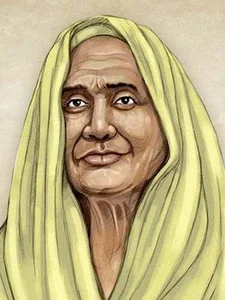
Women organised, marched, picketed, refused taxes, went to prison and died in India’s independence movement. Matangini Hazra belongs inside that history, not above it.
Section 01
1930: the year the numbers changed
Indian women had taken part in nationalist politics before 1930 — in the Swadeshi agitation after the partition of Bengal in 1905, in the Home Rule movement, in revolutionary organisations. But participation was largely confined to educated women of the towns.
The Civil Disobedience Movement changed the scale. Gandhi initially did not intend women to join the Salt March itself; Sarojini Naidu and Kamaladevi Chattopadhyay argued him out of that position. Once the question was settled, participation moved far beyond the small circle of women who had made the argument.
Village women broke the salt law. Women picketed shops selling foreign cloth and liquor — a campaign Gandhi assigned to them specifically, and one that produced arrests in unprecedented numbers. Estimates of total arrests during the Salt Satyagraha run to tens of thousands of men and women.
This was the opening through which a widow from Hogla with no schooling could become a participant in national politics. The movement had, for the first time, developed forms of action that did not require status to join.
Section 02
What that participation actually consisted of
“Women took part in the freedom struggle” is true and tells you nothing. These are the specific roles the record describes.
Breaking the salt law
Manufacturing salt in open defiance of the state monopoly — a deliberately arrestable act, performed publicly. Matangini Hazra did this at Alinan in 1932.
Picketing
Standing outside shops selling imported cloth and liquor to dissuade customers. Sustained, exposed, and the single largest source of women’s arrests in the period.
Spinning and khadi
A political act that could be performed inside the household. It made participation possible for women whose movement outside the home was restricted.
Refusing taxes
Joining no-tax campaigns such as the chowkidari tax agitation in Bengal — collective refusals that required no literacy and no money, only agreement.
Imprisonment
Serving sentences in colonial jails, often far from home. Matangini Hazra served six months at Baharampur, in her sixties.
Processions and flag-raising
Public assembly in defiance of prohibitory orders, and the raising of the national flag over government buildings — the objective of the Tamluk action in 1942.
Organisation and relief
Running local committees, carrying messages between them, and organising relief — particularly after the Medinipur cyclone of October 1942.
Section 03
The Bhagini Sena
In the Tamluk region in 1942, women’s participation took a form with few parallels anywhere else in the country.
During the Quit India rising in Medinipur, a women’s wing was organised as part of the local movement — the Bhagini Sena. Historical accounts of the district describe it as an organisation of women volunteers without close equivalent elsewhere in India at that moment.
Its members received training, and accounts record that they were issued daggers for self-defence — a response to the sexual violence that accompanied the police and military repression across the district after September 1942. This is a difficult element of the record and it is frequently left out of popular retellings. Leaving it out misrepresents both what the movement faced and what its women organised against.
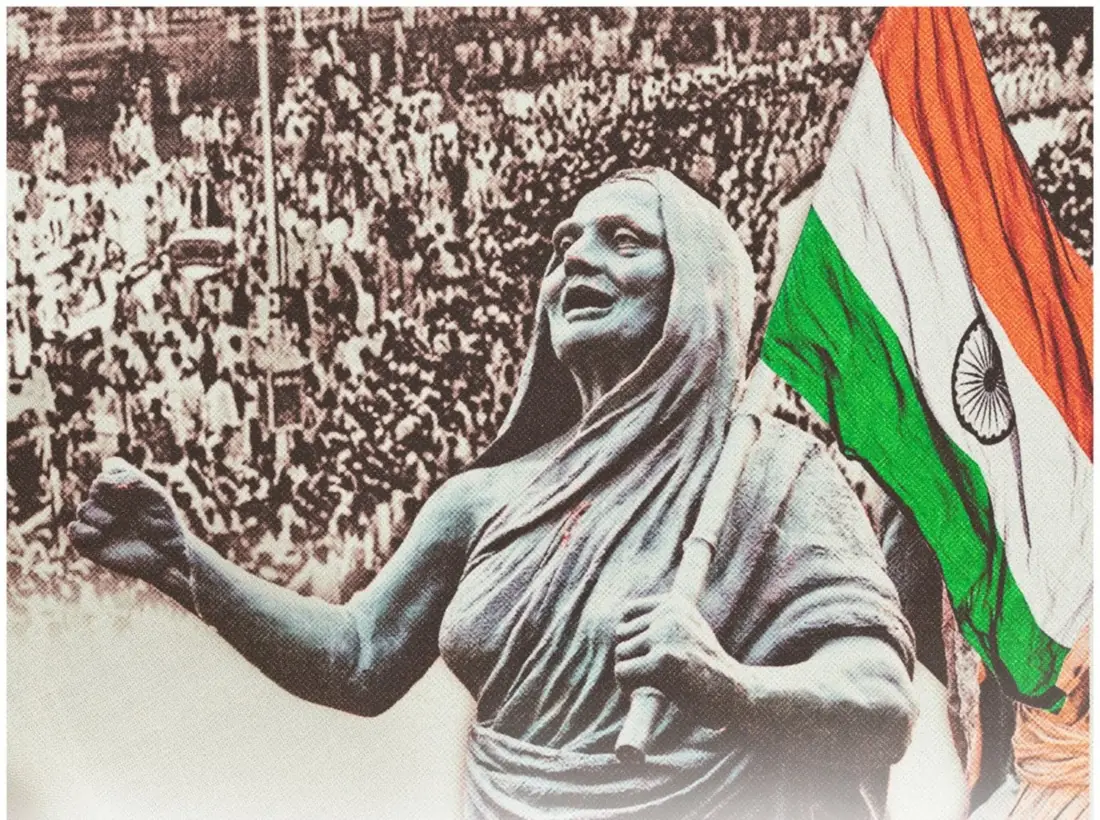
The procession Matangini Hazra walked at the head of on 29 September was, by every account, made up largely of women. That is not incidental colour. It is the central fact about the composition of the movement in Tamluk.
Section 04
Why so few names survive
The historical record is not a neutral mirror. It preserves what generated documents, and in colonial India documents were generated by property, office, litigation, education and publication — almost none of which touched the lives of poor rural women.
So the women who appear by name in the national narrative tend to be those who had access to at least one of those things: the writers, the organisers’ wives and daughters, the graduates, the wealthy. That is a bias in the archive, not a measure of who did the work.
Matangini Hazra is an exception, and it is worth being clear about why. She is named because she was killed, in public, at the head of a large procession, in a district whose movement then established a government that could commemorate her. Had she survived, she would almost certainly be as anonymous as the several thousand women who walked behind her that morning.
A note on how this history gets told
Against the inspirational summary
Women freedom fighters are commonly presented as a list of brave individuals, each introduced with an adjective and a date of death. This is a poor way to teach the subject. It converts a mass political phenomenon into a set of personal virtues, and it implies that what was required was exceptional character rather than organisation.
The more useful questions are structural. What forms of action allowed women to participate without the permission of their households? What did the movement offer that made the personal risk worth taking? Why did participation reach the scale it did in some districts and not in others?
Matangini Hazra’s life answers several of those questions concretely — which is a better reason to study her than the manner of her death.